Chapter 2: Cleethorpes, 1975
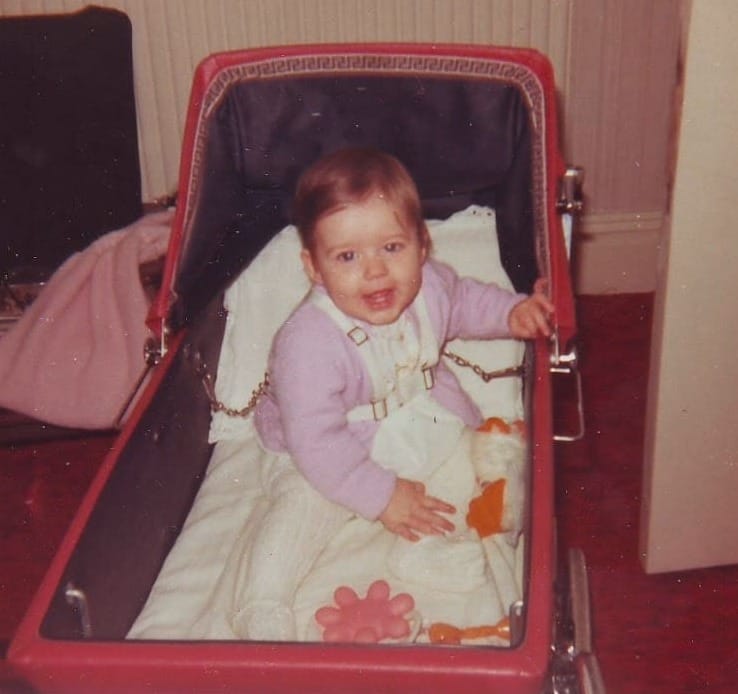
On the afternoon of Monday 24th February 1975 at Croft Baker Maternity Home, Cleethorpes, I was born to my mum Dot and dad John.
Situated in Mill Road - now a conservation area - Croft Baker was only a couple of streets away from our house in Wollaston Road. My mum, therefore, didn’t have to go very far to pop me out, and it was a short walk for my dad and sister to visit.
To be born in Croft Baker is to be able to claim you're a Meggie, a name bestowed upon anyone born on the hill ascending from Cleethorpes seafront. Being one of only two maternity homes in the area for a long time, all children born in Cleethorpes during this period were born in one or the other, making them Meggies by birthright. Although it had been a maternity home since the 1920s, Croft Baker only became known by this name in the 1960s when its popularity was on the rise; hence it is somewhat legendary among people of a certain age group who were born there. The very dropping of its name can be used the world over as proof of your heritage, should a fellow Meggie ever request it (and yep, it happens). Following its closure in the 1980s, maternity care was transferred to nearby Grimsby Hospital, meaning that no true Meggies have been born since then.
There has always been much debate over the origin of the word Meggies. One enduring theory is that Cleethorpes was once the destination of smugglers who brought exotic spices, such as nutmeg, from far-off lands to our shores, and the shortening of nutmeg to 'meg' eventually led to Meggies being used in reference to the town's settlers. Whatever story you choose to believe, Meggies is still used today as an affectionate nickname to refer to the town itself, as in: You off up Meggies later?
My one and only sibling, Lynn, had enjoyed a whole four years of being an only child and the centre of my parents' attention. When I was first brought home to Wollaston Road, Lynn peered into the pram to look at me and I announced my arrival by kicking her clean in the face with my little chubby leg. She got her revenge not long after I’d started walking, by sticking her foot out to trip me up when I entered our living room, sending me flying head-first into the hot radiator, resulting in a bump to the forehead and a cold flannel press amid much dramatic wailing. Following this early exchange of violence, we thankfully arrived at a kind of unspoken peace agreement, and have got on well ever since.
Wollaston Road is a typical northern street of ‘two up, two down’ terraced houses, running downhill from the road that leads almost directly to the pier, to Clee Road, the main road that takes you out of Cleethorpes, through the Grimsby suburbs and out to the edge of the Lincolnshire Wolds. For the benefit of those not from the area, I should explain that Grimsby and Cleethorpes are essentially two separate towns that sit together, forming a conurbation. Unless you are aware of the geographical border between the two, you would not realise you had passed from one to the other. Depending on where I am and who I’m talking to, I may refer to myself as either a Grimbarian or a Meggie. Having been born in Cleethorpes, raised in the surrounding countryside, and educated in Grimsby, I feel comfortable claiming either title.
Another honour which can no longer be bestowed upon a person born in Cleethorpes is that of hailing from the county of Humberside. Bordered by Yorkshire to the north and west, and Lincolnshire to the south, Humberside existed only between 1974 and 1996, which covered the entire time I lived there.
I believe that the abolition of Humberside somehow took away some of the identity of Cleethorpes and Grimsby. Previously you knew that Humberside was exactly that – a county encompassing the area around the banks of the Humber Estuary, which included Hull on the north side, and Grimsby and Cleethorpes on the south. This change caused much confusion to those who were previously able to pinpoint Grimsby to a county, but following its abolition you could no longer do that – it was suddenly unclear which county it belonged to, and from then on you could almost guarantee that anyone hailing from Grimsby would be asked one of two questions: Does it stink of fish? or Is that in Yorkshire?
We lived in our house on Wollaston Road until 1978, when I was three years old, so my memories of it are hazy and largely influenced by the photographs we have of that time and what the rest of the family have told me. Whenever I pass it as an adult, I’m surprised at how tiny it is compared to my memories of such a cavernous place. I may also have mixed my memories over the years with those of my Grandparents’ house in Retford, Nottinghamshire, which (in my mind, at least) had a similar layout.
A typical two storey pebble-dashed terrace, with a back garden surrounded by a brick wall and a big blue gate that led out to an alleyway running along the back of the houses, our house was fifth from the top of the hill, and we were not far from the hustle and bustle of the high street and the two main shops where my mum used to buy our groceries; Liptons and Fine Fare (Mum would tell my sister and I that we were born respectively in Liptons and Fine Fare carrier bags. Delighted as we were to be told this story again and again, it saved her the bother of explaining where babies really came from for at least another ten years).
Our house was also not very far from the seafront, but as a kid it seemed like a huge distance away, which made it all the more exciting to be taken there on days out by our Grandad, who loved to take us on the swings and fairground rides (some of which are still there, although I wouldn’t like to attest to their safety after all these years). One of our favourite rides – a small ferris wheel – was always referred to in our family as 'Grandad’s wheel', which for far too long I believed to be its actual name, until one day it finally dawned on me that the blank looks I was getting whenever I mentioned it to anyone were not because they were impressed that it was named after my Grandad.
I have very hazy memories of the upstairs of our house, except for a vague recollection of being wrapped in a gigantic fluffy yellow towel in the bathroom at the top of the stairs like a new-born chick, and of spending a night in my sister’s bedroom, keeping her awake talking about a toy car I particularly liked (a blue Ford Escort - god knows how I remember the minutiae of this conversation, and yet have forgotten the entire upstairs of my house). I have no idea how I came to be sleeping in my sister’s room, but my best guess would be that we had guests who were sleeping in my own room.
Downstairs there was the living room or lounge as it was known. Decorated in a typical 1970s swatch of amber, brown and red, with G-Plan furniture and a black vinyl three-piece suite that would now cost a small fortune, it was a mid-century enthusiast's dream. When I look at photographs of us in this house, I always look to the background, full of items that I now regularly covet for my own home fifty years later. I sometimes wonder whether these exact ones are still out in the world somewhere, in someone’s house or a vintage shop.
As well as the lounge, there was also a sitting room. I can’t remember much about this room, but the photographs suggest we spent quite a lot of time here playing with our toys. It also appears that the television set spent some time in here before re-appearing in the lounge in later photos. Apart from The Flumps, I don't remember watching it very much at this age.
At the back of the house was the kitchen, preceded by an adjoining dining room with a bay window to the side where a dining table and chairs sat. With my sister out at school by now, this is where I would be plonked during the day by my mum so she could keep an eye on me while she was doing housework. On one occasion while she was getting the dinner ready, Mum sat me down at the table with an empty plate in front of me while she went out into the garden to hang up some washing. I remember watching her through the window, and I think she must have gotten into conversation with the neighbour as she was gone for what seemed like a long time. Being an impatient child, I reached for the squeezy plastic salad cream dispenser on the table and decided to squirt out the condiment in readiness for my food. As I squeezed out a blob and let it settle into a glossy pale yellow circle on my plate, I noticed a tiny air bubble and decided I needed to pop it by squeezing more salad cream over it, but once I’d done that, several others appeared. I was so determined to get a bubble-free blob of salad cream that I kept squeezing and squeezing, and it felt like nothing else existed outside of what I was doing. It wasn’t until my mum came in from the garden and lost her mind over the mess that I snapped out of it, and it became apparent I’d squeezed out the entire container. While being one of my most enduring memories of infancy, it wouldn't be the last condiment incident I would have in my early childhood - the next one involving vigorous shaking, a loose cap, and a shower of ketchup all over my mum and our nice wood-panelled walls.
In the summer of 1976, the British Isles suffered a heatwave which recorded the second hottest temperatures since records began, as well as a severe drought. Accumulatively, this made it one of the driest, sunniest and hottest summers of the 20th century. During the drought’s peak in August, parliament responded by passing the Drought Act 1976. According to internet sources, as the hot and dry weather continued, devastating heath and forest fires broke out in parts of England. 50,000 trees were destroyed at Hurn Forest in Dorset. Crops were badly hit, with £500 million worth failing. Food prices subsequently increased by 12%. With this in mind, my mum’s somewhat irked reaction to the wasted salad cream incident was entirely justified.
I remember our garden always being a hot place, since my main memories of it would have taken place during this heatwave. The photographs show us out there in colourful sunglasses, on deck chairs with little or no clothes on, chucking water at each other in the paddling pool. My poor mum though, having to keep the house and a couple of infants in check during this heat, must have suffered. Although she tells us we were well-behaved, I would personally have found looking after two small kids in heatwave temperatures pretty exhausting.
I don’t remember ever going outside the blue gate to the alley, but my mum has told a story for most of my life that we once went out there and a big dog jumped up on me, and subsequently I was terrified of dogs as a child and would cry whenever one came anywhere near me. This always baffled me because, firstly I have no recollection of such a thing ever happening, and secondly, I always adored and played with dogs as a kid. Only a couple of years ago, my dad overheard my mum re-telling this story and corrected her; it hadn’t been me the dog jumped on, but my sister (even so, I don’t recall Lynn ever being terrified of dogs either). My mum mixing us up or embellishing stories from our childhood was a trend that continued throughout our lives.
My sister and I not only looked different but also had different personalities. While Lynn was tall and skinny with lovely long blonde hair and bright blue eyes like my dad’s, I was pudgy, with dark brown hair and dark blue eyes, unlike anyone in my family, although by the age of five I’d somehow become as thin as a rake, earning me the nickname Boney Em. My sister was quiet, studious, thoughtful and creative. I on the other hand was constantly talking (usually to myself), had a slapdash attitude to everything, and was completely oblivious to risk or danger. However, our personalities seemed to complement each other somehow, and we’d happily play together without much argument. Over the years we’ve each grown more like the other in personality, and the attributes that were unique to each of us as kids are now more equally balanced between us.
While my sister was at primary school during the day my mum would take me to what was then known as ‘playschool’. My memories of playschool are vague, but slightly ominous. The room it was held in, a community hall within an old school on nearby St Peter’s Avenue (now replaced by a modern church), seemed gigantic to me, and we infants took up a very small area of it. Within this room was another smaller room, which I guess was just a storage cupboard, where all the toys were kept. There was no light in that room and on the rare occasions that its door was opened, I would peer in through the crack and be frightened by the pitch dark, imagining all sorts of hostile things lurking inside the blackness. Despite this perceived threat, I was more than happy to pick a toy to distract myself with until it was time for Mum to come and pick me up. It comes as no surprise that I don’t remember any of the other kids because I preferred to play alone, completely immersed in the colourful world inside my mind, which I would nonsensically narrate out loud. The only time I remember coming into contact with another kid was when a little boy in a blue jumper brazenly tried to take my favourite toy - a little red fire engine with yellow pedals that I would sit on and drive around the room. Being a non-confrontational sort, I let him take the toy, but for some reason I never forgot the awkwardness of losing my ‘crutch’ and the horror of standing exposed with nothing to hold onto, not knowing what to do.
In 1978 my parents decided to move us out of town to a village in the surrounding countryside, the idea being for my dad - who worked at Humber Oil Refinery on the south Humber bank - to live closer to work. On moving day, I sat halfway up the stairs opposite the front door, rolling my tongue in my mouth (which I distinctly remember doing, having just discovered it) and watching people go back and forth carrying boxes and bits of furniture out of the house. I would not become a townie again for another fourteen years.